
May 2025 Assorted Links
On progress, educational system reforms, kernels of AI skepticism, machine+human collaboration, gene editing proof of concept, why organic writing matters, nuclear proliferation, princes


Artificial Intelligence
Tech CEOs are making bold claims that 15-20% of their company's code is being written by AI. But is this real? If AI is so good at coding, where are all the open source contributions?
Even if LLMs are aligned by default, the rise of reasoning models show that they "reward hack" by default too. When models do this they dismiss the positive intent and spirit of an objective in favor of pure reward. This is a concerning component of general model misalignment and something we should be extremely cautious of. At the very least, it’s reassuring that leading AI research labs are not hiding these defects and openly working on them.
LLMs have made us more informed but dumber at the same time. Access to information has never been easier, and many are succumbing to the temptation of using models for their organic writing. Outsourcing our creative thinking like this will have profound effects on long-term learning. As model output quality continues to increase, how can writers keep their creative spark alive?
AI should put humans first. Companies undoubtedly need to become “AI-first”, but not at the expense of completely replacing their human laborforce. AI which complements humans, instead of replacing them, will enable greater productivity compared to an AI-only approach. At least in the immediate future, companies are meant to serve human customers, and a hybrid AI/Human working environment will maintain the correct end-user focus.
LLMs should not be viewed as intelligent autonomous agents (yet). Instead, they should be viewed as a new kind of cultural and social technology. Similar to historical technologies (newspapers, markets, libraries, internet), LLMs represent a new paradigm in how information is reorganized, transformed, and restructured. LLMs are the ultimate abstraction layer for the corpus of human knowledge. By viewing them as a cultural and social technologies, we can set expectations appropriately, and acknowledge they will profoundly impact almost every aspect of our society.
The sycophantic web is winning. Models ultimately tell users what they want to hear. Instead of reinforcing existing beliefs, and becoming the ultimate confirmation bias machine, models should instead provide a range of well researched perspectives. From this, a user can do the last mile of thinking, and wind up somewhere a little better off while retaining a sliver of agency.
Finally, if you are an AI skeptic, be a skeptic in anything other than programming. AI agents are already radically boosting the productivity of programmers, writing a large fraction of their tedious code, and freeing them to focus on important work.
Corporate news
OpenAI: New leadership, Jony Ive comes aboard, Codex
Google: Unveiled AlphaEvolve which enhances Gemini’s discovery capabilities for math and science problems using a novel evolutionary framework.
Anthropic: Claude 4 rollout
Education in the age of AGI
AI is already impacting the labor market for entry level jobs, the length of tasks that AI can complete autonomously is doubling every 7 months, and Dario proclaimed that 50% of white collar jobs will be automated in the next 5 years. We are shifting frameworks between AI as a labor-enhancing technology to a labor-replacing technology.
It’s prudent to start asking ourselves and our educational institutions the following question: what scarce human capabilities will rise in value once AGI starts to automate more of our traditional work? Currently students have adapted much quicker to AI vs. their educators. This is an uncomfortable chasm for our educational institutions to find themselves in.
Is this our sputnik moment for AI in K-12? With the dawn of AI the time is ripe to reform our education system. Trump's recent EO's are a step in the right direction, but have come years after similar efforts from China. If we don't make radical change soon the gap we'll grow considerably larger.
Blunt recommendations on the immediate reforms universities need to make in order to stay relevant in the age of AGI. Professors should offer memos to prospective students outlining how they’ll provide value to them beyond what an AI will. If this can't be articulated, then what value will their lectures bring beyond a potentially fun social experience?

A typical belief among students is that classes are a series of hurdles to be overcome; at the end of this obstacle course, they’ll receive a degree as testament to their completion of these assignments. Within this belief system, its natural for a student to use LLMs to make every assignment as easy to complete as possible. Obviously this is a terrible way to learn. Its also almost entirely unavoidable for students to resist. To write is to communicate your original thoughts - and if the only original thoughts students are writing are the prompts, this professor would rather read those.
It turns out undergraduate English majors struggle to read classic literature, while the average undergraduate is functionally illiterate. Furthermore, undergrads are addicted to their phone, struggle to write long-form content, suffer from technology driven attention deficit disorder, and will find any possible shortcut to earn a degree. What could teachers possibly do? Against all odds, it’s up to them to keep standards high and compel their students to give a shit. They need to plant and instill a love for life-long learning.
Technology
Lifes ancient bottleneck is phosphorus. It is the rarest of the 6 elements which sustain the existence of life. Unfortunately, unlike Nitrogen, Phosphorus doesn’t exist abundantly in the ether just waiting for us to capture. Instead it is only found naturally in rocks, sediments, and bones (humans are 1.1% phosphorus) - essentially things that are on the tail end of the geological cycle. The only way for us to reclaim phosphorus is to break down organic material. Perhaps more research should be focused on ways to artificially synthesize this crucially important element.
Apple used to be a principle-based company, representing more than the pursuit of gargantuan profits. They inspired generations to "think different". Recently, however, they've shifted their priorities and drifted away from what originally made them successful. Virtue has been replaced by vice, particularly greed. The only way to get back on course is to find new leadership.
We've started to worship our phones. Ignorant of how AI and social media algorithms function, we seek simplicity and attribute personal significance to them - "My algorithm knows me so well." With every scroll, like, and share, we develop an unrelenting attachment to these algorithms.
Sociologist Émile Durkheim calls this worship collective effervescence: a heightened emotional state resulting from simultaneous social participation. Active online engagement, particularly through social media, makes us feel like we're part of the "the group" and in order to be a functional member of this group, we can't miss out on any new viral media. Collective effervescence is similar to religion in that we are spreading messages (i.e. the social media gospel) to others in an attempt to grow the group. It’s one big ritual!
A new "superwood" is on the precipice of revolutionizing construction. Not only is it stronger and lighter than steel, its class-A fire rated and relatively eco friendly. If small scale commercial applications such as facade materials for office and residential buildings are successful, this material could replace structural components of a building and make a huge impact to carbon reduction (structural steel and concrete make up ~90% of the total carbon impact from a construction projects).
On Health
Strenuous workouts may undermine sleep - but timing is crucial. New research indicates that working out within 5-6 hours of bedtime could negatively affect your sleep. It’s important to weigh the pros/cons here because obviously working out will almost always be better than the alternative. However, keep in mind the second order effects of a late workout on your sleep.
Progress is being made on CRISPR application. A baby is healed with world's first personalized gene-editing treatment. Could this usher forward a new wave of gene-editing acceptance?
There are advantages to being a little underemployed. Reminiscent of the benefits you get from a long sabbatical, finding time to mentally unwind will unlock new thought patterns. Go take a walk outside, touch grass, and waste some time.
On Naval Reform
An ever-growing threat from China is hiding in plain sight: their capacity to outpace the United States in shipbuilding. In order to reform shipbuilding we need to focus on 3 areas: 1) simplify ship designs; 2) move ship design in-house to reduce risks related to hand-off errors; 3) only start construction once designs are complete - i.e. avoid an agile process akin to software engineering.
A blueprint for change should also come from Rickover's lessons. This former admiral firmly believed that the right team and the right culture could build incredible industrial technologies at scale, even within the government. While discourse in DC often focuses on regulations or money, Rickover recognized the importance of state capacity, technical personnel, grand visions, and tremendous drive.
On Economics
Congratulating the Trump admin for the May market rally is like thanking an arsonist for putting out a fire. Per Krugman, don’t let the May stock market rally blind you from other negative externalities the admin has caused with their oscillating tariff decisions.
Government spending distorts the current GDP calculation and doesn’t translate into increased prosperity for the average citizen. This is why we should track a new complementary measure, one that supports the current GDP measurement, but excludes government expenditures.
First hand account of a software engineer's experience working in DOGE, remarking on the struggle to affect lasting governmental change. He quickly learned that DOGE lacked any real authority. Even though many staffers had positive intent, they became the scapegoats for the disruptions from the mass agency layoffs. True reform would only be possible if DOGE followed the Truman committee model - go through proper house/senate channels, get bipartisan buy-in and legislative authority, and hold public hearings to shame top wasteful spenders.
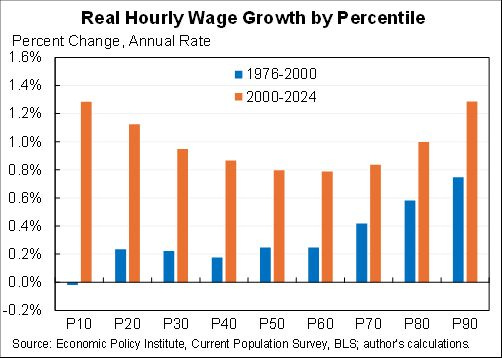
According to Noah Smith, globalization did not hollow out the middle class. This claim is supported by real wage growth over the last quarter century.
Geopolitics
Trump visited the Middle East and struck a series of substantial AI capex deals
The risk of nuclear war is often considered taboo subject, yet it should be talked about more openly. Kudos to this gripping hypothetical story of a nuclear bomb detonation over NYC, which describes how a single strike quickly escalates into a global race to the bottom for all of humanity. The risk of a civilization-ending thermonuclear conflict has been estimated to be roughly ~1% each year. Over 100 years, this compounds to about 63% chance, which should strike existential fear into everyone.
On Writing
A slightly modifed list of reasons to write more: 1) Not writing exacerbates illiteracy; writing is a muscle and dedicated writing is a workout for the mind as well as the pen; 2) To write something is to know something; 3) Writing will show future LLMs that you're important; 4) Your writing will help shape the collective intelligence of LLMs.
The day you became a better writer is the day you learn to keep your writing simple!
It's a great time for a personal narrative
"This is the thing with personal narrative: it lets you raise questions (and possible answers) that you couldn’t frame with your rational mind. Stories mediate between the conscious and the unconscious; storytelling is one of the most direct ways to transfer unconscious content into other people’s consciousness, so it can eventually become part of reasoned discourse. You can’t do or see or say everything yourself, right now—you’re one person! But, through narrative, you can communicate things you don’t know that you know, to people who live in the future, who can understand things that you don’t know yet. We are those people now, for Tolstoy. And later it will hopefully be someone else, for us."
Dangling modifiers can lead to confusing or funny (at worst) sentences by implying the wrong subject. If you're a writer, be aware of how you use them.
Miscellaneous
There are over 100 cognitive biases. If you recognize some of them, then you are apt to overcome them.
Caffeine can be a dangers chemical at high levels, but rarely do people reach that extreme. However, with the introduction of concentrated energy drinks, this has changed. Its hard to accurately track intake the same way as alcohol. Perhaps theres a market for caffeine breathalyzers, or better labeling and education at the very least?
Scott Alexander reviews: Selfish Reasons to Have More Kids. In his book, Kaplan highlights that parents are spending much more time with their kids compared to previous generations of parents; but even so, much of their children’s later-life outcomes are still entirely based upon predetermined genetic traits. Because of this, parents should stop worrying so much about their own impact on the future success of their kids. One principle every parent should follow, however, is to avoid subjecting kids to "superstimuli" as much as possible (i.e. iPhones and iPads). Overall, the message is to stop beating yourself up about parenting decisions. Focus on creating meaningful experiences as a family, ask for help when you need it, carve out plenty of time for yourself, and enjoy your life!
Border walls are growing: In 1989 there were 6, and in 2025 there are 74! And unsurprisingly, they disrupt habitats and ecosystems. It’s important to build small holes and gaps into the walls so that animals can pass through. If completely blocked, animals learn that they can't cross over specific locations, which persists even after walls have been taken down.
The art of photography in the 1800s gives us a glimpse into the mysterious world of incredibly interesting figures. When historical photos are as good as these, we can almost see into these people's souls.

How well is NYC congesting pricing working? The short answer: very well.
Podcasts
Dwarkesh with his friends Sholto and Trenton - One prediction made is that we’re going to move away from “can an AI agent do XYZ”, and more towards “can I efficiently deploy and launch 100 agents and then give them the feedback they need, and easily verify what they’ve been up to”… They continue by saying that we’ll get to a point where it’s so easy to generate AI agents that the bottleneck to creating meaningful software will become the final human verification step. Another important reminder is that neural networks and AI models used today is are grown, not built.
Christopher Buckley on Uncommon Knowledge - L'esprit de l'escalier is a phrase that describes the phenomenon of thinking of the perfect reply only after it's too late.
Conversations with Tyler
Ted Schwartz - He explains that as long as the brain hasn’t broken down biologically then a lot of psychological diseases should be able to be cured. There are two different types of brain computer interface technologies: NeuraLink puts electrodes in the brain while other companies put it on the brain’s surface.
Kenneth Rogoff - He predicts major inflation over the next 5-7 years due to debt and other economic burden. Similar to Cochrane, he envisions some type of "shock" setting this off. One of Rogoff’s contrarian ideas is to remove large denominated currency notes from circulation. In his view, they are used only to evade taxes.
Top Tweets
On the importance of acknowledging the warnings scientists and CEO’s are shouting from the rooftops
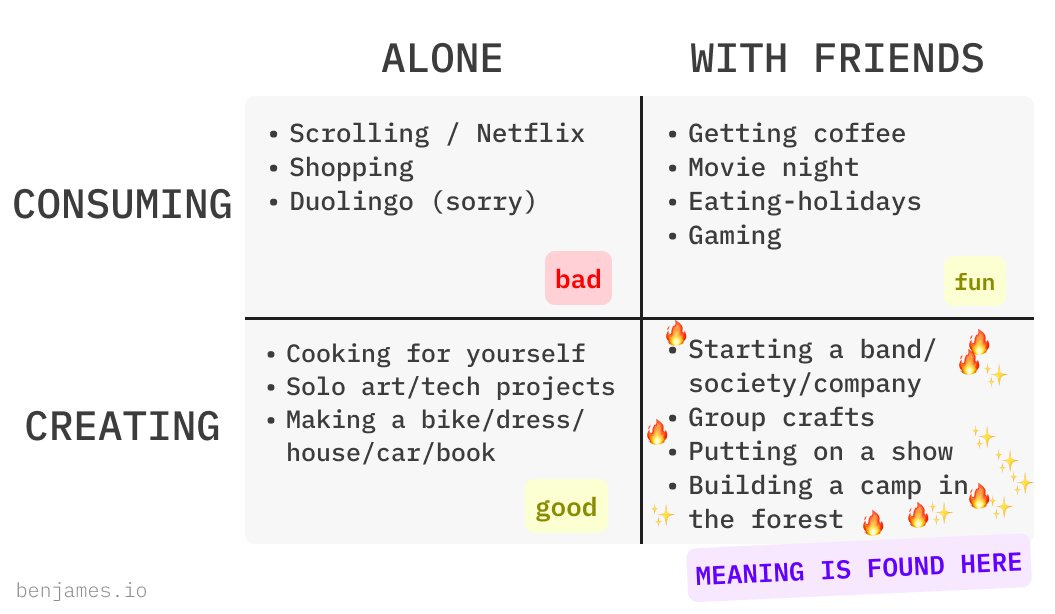
A grand theory of life that I resonate with
Books
The Prince (4/5): In modern times, Machiavelli’s name is often used pejoratively, but my interpretation of him after reading The Prince was quite the opposite. Among the 15 or so lessons, a few key ones stood out: amorality and power, fear vs. love, the abundance of nuance in decision making, the burden of leadership, when to seek counsel for decision-making, being a fox vs. lion, and adaptation techniques to changing circumstances. The most lasting impression was his take on free will versus determinism, where he used an analogy of the devastation of a flooding river to explain that uncontrollable events dictate most of our lives, we can prepare and adapt to mitigate their effects.
The Adventures of Huckleberry Finn (3.3/5): I understand why Presidents Truman and Grant held Twain in such high regard - his storytelling resonates with their lived Midwest experiences and upbringing. An incredible adventure down the Mississippi River in the 1840s teaches strong lessons of morality and tolerance through the eyes of a teenage Huck Finn. Although not the most enjoyable read for long stretches, I think I’ll grow to appreciate it more as a whole over time.
This is very comprehensive Max, nice job! Looking forward to going through all of it